

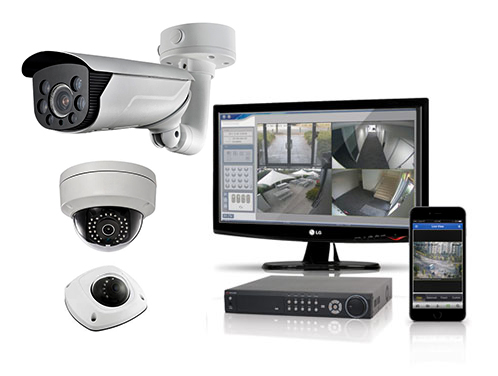
What is CCTV? Why is there a need for CCTV Monitoring Singapore?
CCTV is the abbreviation for Closed Circuit Television. It is a visual surveillance technology system designed to monitor the desired surrounding environment and its activities. In recent years, the role of CCTV has grown to unprecedented levels. Originally used to deter crime and ‘anti-social behavior’ such as minor offenses like littering, urinating in public and etc, CCTV monitoring now plays a more important role, assisting the police and security organizations in their investigations. Britain is currently the leading nation in implementing CCTV, most British towns and cities are moving to CCTV surveillance in public areas, housing estates, car parks and public facilities.Other countries are quickly following. North America, Australia and some European countries are installing the cameras in urban environments which a few years ago would most likely have rejected the technology In Singapore, an extensive round-the-clock CCTV surveillance system covers majority of the highways and roads island wide, providing 24 hours visual surveillance on traffic situations. With the system, authorities are able to response faster to traffic situations. In recent years, there is a vast increase in demand for CCTV applications. Thousands of cameras are installed island wide. They can be found in various places such as shopping malls, boutiques, bus terminals, MRT stations, underpasses, Automatic Teller Machines ATM, sensitive government buildings, private estates and even extending its application to red-light districts, in an attempt to monitor and deter illegal activities. CCTV is fast becoming an integral plan for crime control policies and social behaviour control theory in an effort to maintain ethnical public behaviour and public order. It has become an icon for security and its presence is guaranteed to generate a sense of security and welcomed by many.
CCTV monitoring singapore. Our CCTV Surveillance system is a complete self-sustaining intruder detection system which will protect larger civil construction sites from unwanted visitors.
The System provides that extra layer of ‘exceptional’ to your projects. Whether your goal is to reduce job site theft, ensure OH&S compliance, better manage projects from the road or keep clients up-to-date with site progress. The CCTV System delivers an affordable, easy to use, remote job site monitoring solution.
Benefits of Using a CCTV Monitoring Services in Singapore on Your Construction Site
If you’re wondering whether to install a CCTV system on your construction site, here’s a rundown on the benefits of using CCTV system in the construction field.
- Supervise Your Construction Workers with a CCTV System
- Determine How Resources Are Being Used
- Analyze Your Construction Project’s Progress
- Prevent Crime
- Aid in a Criminal Case
- Aid in a Civil Personal Injury Lawsuit
- Manage Your Site Remotely
- Promote Worker Safety
- Record Injury Accidents Involving Workers
- Gain Feedback in Real Time
- Help with Insurance
- Maintain a Peace of Mind
- Enjoy Around-the-Clock Coverage
How We Can Help
We offer top-of-the-line video surveillance systems for construction managers and other business leaders
Our systems come with a variety of convenient features, including a 360-degree-view of your site.
Contact us to find out more about how a CCTV system can add value to your work site this fall
How to choose a suitable CCTV camera for your needs
Choosing the correct CCTV Camera that fits your digital surveillance requirements is very important. Below is a simplified set of guidelines when choosing the correct CCTV camera for you application.
a) Location: Indoor or outdoor application
b) Requirement for day and night surveillance
c) The angle of view requirement. Wide angle coverage or a narrow field of view is required.
d) Budget
7. How does focal length affect angle of view?
Focal length is measured in mm. A short focal length (e.g. 3.6mm) represents a wide angle of
view while a long focal length (16mm) represents a narrow angle of view.
8. What is Auto and Manual Iris?
Auto Iris lenses are lenses that are able to change the size of their iris in accordance to
its surrounding light condition. When the camera mechanism detect that there is insufficient
light, the lens will automatically enlarge its iris to accommodate more light in so it could
focus properly and produce images that are not too bright or too dark to see. It will do the
reverse when it’s too bright. For outdoor applications, where the light conditions are
constantly changing, auto iris lenses are needed.For indoor applications, where light
conditions are constant most of the time, a manual Iris lens would be sufficient for the
application. Manual iris lenses provide an effective solution for applications where the
surrounding environment and its lighting conditions are relatively stable. It gives the best
performance when used with cameras that are equipped with electronic shutters.
8. What is the difference between video driver and a DC driver in an auto iris lens? Auto iris lenses need a driving circuit to control and operate a motor to adjust the aperture range in accordance to varying light conditions. The driving circuit can be placed on either the camera lens or inside the camera itself. For video driver function, the control circuit is found on the camera lens. DC driver function camera has the control circuit built-in in the camera itself.Depending on the type of lens and camera you are using, you should always set it to the correct setting in order for the auto iris function to operate correctly
9. What is Day and Night Camera?
Day and night cameras are cameras that are able to provide video surveillance even at low
levels of illumination. A day and night camera displays a full colour image during the
daytime but produces monochrome (Black and white) video images at times when the lighting is
poor. The camera has a device that is sensitive to the surrounding light conditions and
switches the camera between colour and black & white modes automatically. It is designed to
increase its light sensitivity in poor lighting conditions and at the same time reduce noise
level in the images. However, the day and night camera will fail if the illumination (Lux)
level is too low.
10. What is IR camera?
IR is the abbreviation for Infrared. IR cameras have image sensors that are designed to
sense and process infrared light emitted from IR LEDs. Similar to Day & Night cameras, IR
cameras turned to monochrome mode when illumination falls below a certain Lux. An IR camera
differs from a Day & Night camera in which an IR camera is able to capture video images in
absolute darkness with the help of infrared light source.
11. What is C and CS mounts?
It refers to the 2 different standards of CCTV camera lens mount. The difference between the
two is the distance between the lens and the image sensor. C mount: 17.5mm, CS mount:
12.5mm. Cameras and lenses nowadays are generally CS mount rather than C mount. With CS
mount cameras, both types of lenses can be used. However, the C mount lens requires an
additional 5mm ring to be fitted between the camera and lens to achieve a focused image.
With C mount cameras it is not possible to use CS mount lenses as it is not physically
possible to mount the lens close enough to the image sense to achieve a focused image.
12. What camera housing to use in outdoors and at what IP rating?
Camera housings are of various shape and sizes. Different housing comes with different UP
rating, from dust proof to all weather rating. This system is governed by a number of
European and British standards IP55
• Protected against dust – limited ingress
• Protection against low pressure jets of water from all directions – limited ingress
permitted IP65
• Protected against dust – limited ingress
• Protection against low pressure jets of water from all directions – limited ingress
permitted
• Protection against high pressure water from all directions – limited ingress
permitted
12. What is CCTV DVR?
DVR is abbreviation for Digital Video Recorder, it main function is to compress images
recorded from the cameras into a particular image compression format and store them.
13. What is the difference between a PC-based DVR and an Embedded DVR?
A PC-based digital video recorder is basically a personal computer that has been
modified with hardware and software to work as a DVR. An embedded digital video recorder is
a video recording machine that has been manufactured specifically to record video input from
CCTV cameras. In embedded DVRs there is typically one circuit board with software burned
into its processor chip. There used to be significant differences in features between the
PC-based and the embedded machines. But with recent advancements in the embedded DVR
technologies the differences are becoming less. The advantage of an embedded digital video
recorder is that they are extremely stable and reliable as they consist of fewer circuitry
parts. The software is often written in basic machine code or Linux code which tends to be
more stable. The advantages of the PC-based digital video recorders is that they are easier
to interact with because you use the on-screen menus and a mouse (as opposed to embedded
which you interact with more like a VCR – via buttons). And you tend to have more features
and options on the PC-based machines.
14. What features should I look for in a CCTV DVR?
All DVRs are different. There are various factors to consider when purchasing a DVR besides
price comparison. The basic and most important factors to consider are
i) Number of cameras supported, i.e. number of video inputs
ii) Recording at how many frames per second (fps)
iii) Compression technology used
iv) Hard disk space, number of hard disk it can support
v) Network connection / remote viewing capability
vi) Motion detection or scheduling recording functions
vii) Video backup means, by USB, CD, DVD or other means.
viii) Easy and comprehensive search capabilities
15. What is the term frames per second (fps)?
Frames per second (fps) relates to how many pictures the DVR can record in a second. Real
time recording is about 30 fps. To calculate the fps per camera, take the total fps that the
system could offer and divide it by the number of video inputs. For example, a 100 fps DVR
with 4 video inputs would give u 100/4, 25fps per camera.
16. What is image compression and what are the types of compression formats used?
CCTV DVR converts analog images to digital and save them in hard disk. Image compression
plays an important role of improving transmission as well as reducing storage size. There
are various formats of image compression in the market. Among which, JPEG and MPEG format of
compression are the most widely used formats in the market currently. The major difference
between JPEG and MPEG is in compression techniques. JPEG processes images by compressing one
by one still pictures but MJPEG compresses images sequence by sequence. JPEG compression
method can be divided into JPEG, M-JPEG, wavelet and etc. MPEG compression method can be
divided into H.263, MPEG, MPEG-II and MPEG-IV.
17. Do I need 30 frames per second (fps) recording on all security cameras?
CCTV surveillance systems are generally intended to capture images and not to make movie
quality videos. Recording rates of as low as 1 or 2 frames will be sufficient to capture
critical moments for example, a criminal act in progress. Even at low frame rates, recording
on motion, the compressed video files produced per day are huge in size. Therefore, it is
not advisable to set all cameras to be recording at a high frames per second rate.
18. How many days/weeks of recording can I store?
This depends on the size of your hard drive, the number of cameras, which recording mode (on
motion, on alarm, continuously, etc.), what type of video compression you are using, quality
of resolution used. Please contact our technical support directly for assistance on the
calculation.
19. What is the difference between a simplex DVR and a duplex DVR?
A simplex DVR only performs one task at a time. The DVR cannot playback recorded
videos when it is recording, it can only do so when the recording is stopped. A duplex DVR
is able to playback recorded footages without having to stop recording. Recording is
uninterrupted and taking place concurrently as you playback the recorded videos.
20. What is the maximum length I can pull my cameras away from the DVR?
Using RG59 Coaxial cable, the maximum distance is approx 600 feet away from the DVR and up
to 1,000 feet using RG6 Coax. For longer distances, a video amplifier should be used.